
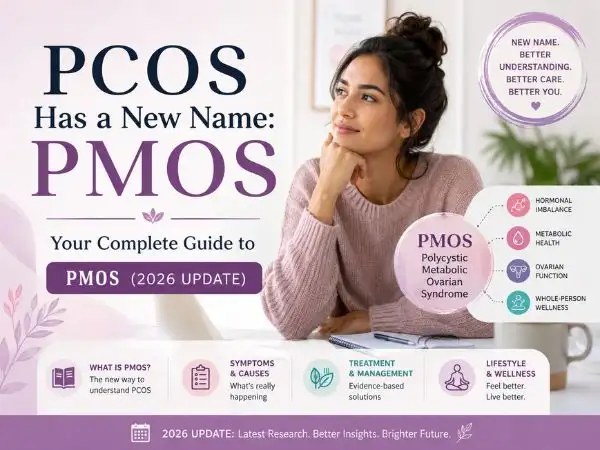
For decades, Polycystic Ovary Syndrome (PCOS) has been one of the most common—and misunderstood—health conditions affecting women globally. Now, in a historic shift for medical science and patient advocacy, the condition has officially been given a new name.

If you have been searching for the “PCOS new name,” wondering about the “Helena Teede PCOS announcement,” or trying to understand “PMOS meaning,” you are in the right place. Here is a comprehensive, up-to-date guide on the shift from PCOS to PMOS, along with the latest on symptoms and diagnostic criteria.
What is the New Name for PCOS? (PMOS Meaning)
The condition formerly known as Polycystic Ovary Syndrome (PCOS) has officially been renamed to Polyendocrine Metabolic Ovarian Syndrome (PMOS).
This name change reflects a fundamental shift in how the medical community understands the disease. Here is a breakdown of the PMOS meaning:
- Polyendocrine: Acknowledges the complex hormonal fluctuations and endocrine disturbances, such as those involving insulin and androgens, that actually drive the condition.
- Metabolic: Recognizes the severe metabolic impacts of the disorder, including its strong ties to insulin resistance, weight management, and the significantly increased risk of developing Type 2 diabetes and cardiovascular disease.
- Ovarian Syndrome: Continues to highlight the condition’s impact on the reproductive system, but does so without overemphasizing reproductive aspects or falsely suggesting that the presence of “cysts” is the primary defining factor.
Also Read : – The Latest Fructose Metabolic Effects Study: Why Sugar is More Than Just Empty Calories
The Landmark Helena Teede PCOS Announcement
Why the sudden change? On May 12, 2026, a landmark global consensus study was published in The Lancet medical journal, officially announcing the transition from PCOS to PMOS. This major update was also formally announced at the European Congress of Endocrinology in Prague.
The renaming effort was spearheaded by Professor Helena Teede, an endocrinologist and the Director of Melbourne’s Monash Centre for Health Research and Implementation. Teede led a rigorous 14-year collaborative process that involved over 50 patient and professional organizations and surveyed thousands of women and health professionals across six continents.
During the Helena Teede PCOS announcement, experts explained that the old term was highly misleading. Dr. Teede noted that the “cysts” commonly seen on patients’ ovaries are not actually true pathological cysts at all; rather, they are simply eggs whose development has been arrested as a result of broader endocrine disruptions.
Because the old name focused so heavily and inaccurately on the ovaries, it contributed to widespread knowledge gaps, delayed diagnoses—with up to 70% of affected individuals remaining undiagnosed—and poor medical care . The transition from PCOS to PMOS aims to reduce the stigma associated with fertility-focused terminology, improve research funding, and encourage earlier, more holistic, patient-centered care.
PMOS / PCOS Symptoms
PMOS affects roughly 1 in 8 women (impacting over 170 million people globally). Because it is a complex, multi-system disorder, symptoms can vary wildly between individuals.
The most common PMOS/PCOS symptoms include:
- Irregular Menstrual Cycles: Patients often experience unpredictable, infrequent, or entirely absent periods as a result of chronic anovulation.
- Signs of High Androgens (Male Hormones): Elevated androgen levels can clinically manifest as severe acne, oily skin, hirsutism (excessive hair growth on the face or body), and androgenic alopecia (female-pattern hair thinning).
- Metabolic Issues: The condition is heavily characterized by metabolic struggles, including weight gain, difficulty losing weight, and insulin resistance.
- Fertility Struggles: It remains one of the most common causes of female infertility due to infrequent ovulation.
- Mental Health Challenges: The condition negatively impacts psychological health, with high rates of anxiety, depression, and poor body image.
If left unmanaged, PMOS significantly increases the risk of serious long-term complications, including Type 2 diabetes, cardiovascular disease, obstructive sleep apnea, metabolic steatohepatitis, and endometrial cancer.
Also Read : – The Rise of Drug-Resistant Shigella in the US: What You Need to Know
Updated Diagnostic Criteria for PMOS
Along with the name change, experts are clarifying how the condition should be diagnosed. Under the latest diagnostic criteria, a patient must meet 2 out of the 3 following conditions:
- Excess male hormones (androgens), verified either by clinical symptoms or through biochemical blood tests.
- Irregular menstrual cycles or ovulatory dysfunction.
- High levels of anti-Mullerian hormone (AMH) in the blood, OR the presence of many arrested follicles (polycystic morphology) seen on an ultrasound.
A Major Diagnostic Shift: Professor Teede noted that 60% of women can be diagnosed simply by meeting the first two criteria, meaning they do not need their ovaries assessed in any way. For the remaining patients, a simple AMH blood test can now act as a biomarker reflecting increased follicle number, effectively taking the place of an invasive internal ultrasound, making diagnosis cheaper and much more convenient.
Conclusion
The transition from PCOS to PMOS is much more than just a rebrand. It is a long-overdue acknowledgment of the daily, multi-system struggles faced by millions of women worldwide. By correctly classifying Polyendocrine Metabolic Ovarian Syndrome, the medical community hopes to eliminate the stigma around fertility, improve early diagnosis, and finally provide the comprehensive, whole-body care that patients deserve.